
The Challenge
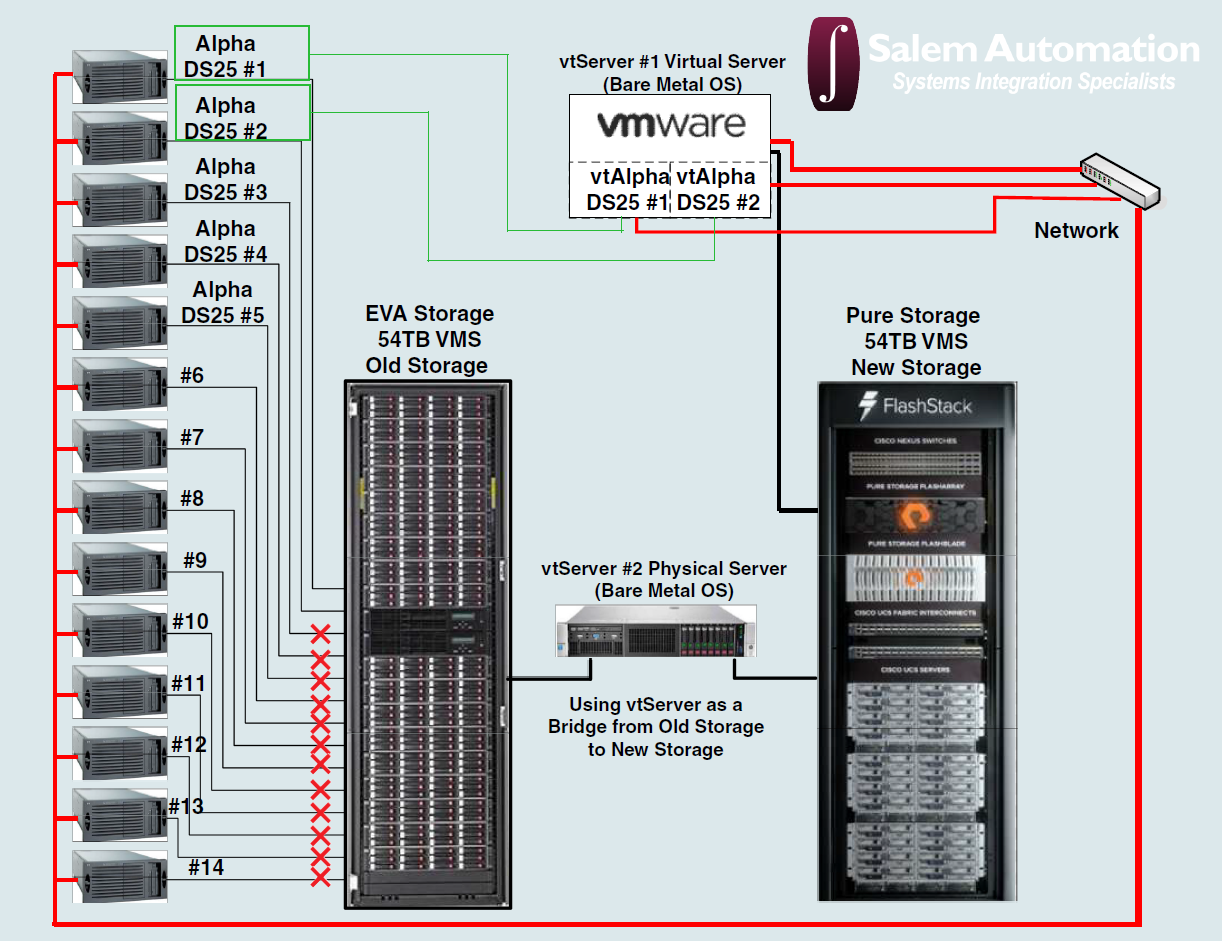
The client operated an OpenVMS cluster consisting of 14 Alpha nodes connected to legacy Fibre Channel storage. With hardware reaching end-of-life and critical support contracts expiring, the organization faced mounting operational risks:
- Aging infrastructure: Dependence on obsolete Alpha hardware with diminishing vendor support and increasing failure risk.
- Expiring support: Imminent expiration support contracts threatened system stability and regulatory compliance.
- Complex data migration: 100 TB of mission-critical data required migration with zero tolerance for data loss or extended downtime.
- Business continuity: Manufacturing operations depended on 24/7 system availability.
The client needed a modernization strategy that preserved their substantial OpenVMS investment, while eliminating hardware dependencies and ensuring long-term supportability.
The Solution
Salem Automation executed a four-phase migration strategy designed to minimize risk and maintain continuous operations throughout the transition.
Phase #1: Infrastructure Foundation
Salem replaced the aging infrastructure with enterprise-grade VMware hosts and modern SAN storage, establishing a scalable platform designed for future growth and improved performance.
Phase #2: Virtualization of ALPHA Nodes
Two Alpha nodes were virtualized using vtALPHA technology and deployed as Multi-Server Communication Protocol (MSCP) servers. This established the bridge between legacy and modern infrastructure, enabling transparent access to existing storage while maintaining full application compatibility.
Phase #3: Data Migration
A vtServer provided connectivity between the new storage infrastructure and the existing Fibre Channel path. Salem orchestrated the migration of 100 TB of production data with zero data loss, leveraging OpenVMS cluster capabilities to maintain system availability throughout the process.
Phase #4: Complete Virtualization
The remaining 12 Alpha servers were virtualized and transitioned to the VMware environment. With all systems successfully migrated, the legacy hardware was decommissioned, consolidating the entire OpenVMS cluster onto modern, supportable infrastructure.